Thursday, March 24, 2011

How Meshuggah invented Djent, and Periphery perfected Djent.


Question: What the heck is Djent, this new genre I've been reading about? Will Earache be signing any bands like that soon? cheers, Anthony

From: anthonyblack323@gmail.com

Answer: Djent is a new name that's been circulating around recently to basically describe a new breed of bands who merge Progressive or Experimental Metal stylings played with Meshuggah style guitar tone and instrumentation. Tech-wise this means 8-string guitars and lots of outboard gear to get that deep guitar tone. Musically its about the drummer creating mesmeric multiple-grooves by use of complex polyrhythms and the guitarist creating their own separate rhythm aswell.Together they can create an intoxicating vortex of sound. Repetition and 4/4 timing is anathema to Djent, the song must be ever-evolving and changing. Long progressive songs about space, time-warps or abstract subjects are the norm in the genre, sung with mostly melodic but also some growl-type vocals.

The name itself stems from an interview Meshuggah guitarist Marten Hagstrom gave when asked to describe in words their fantastically rich, deep, crushing, warped guitar tone- he replied, "it just goes like "Dj-ent Dj-ent Dj-ent".

Watch Meshuggah perform "Straws pulled at Random" for the Djent masterclass from the Swedish expermental metal innovators:


Meshuggah are indeed the sole inventors and forefathers of the entire scene and carved out a unique niche because for many years nobody except them played this style. What has caused the sudden boom is the stampede of younger American fans exiting the metalcore/ mathcore and to some extent deathcore scenes and opening their minds to the more complex playing involved in Djent. Seemingly from nowhere, there has been a sort of Meshuggah-isation among a whole generation of formerly pretty standard metal/mathcore/tech metal type acts.

Musicians who are fantastic on their instruments seemingly want to just play ever more expansive and progressive music. Influences from Tool, Dream Theater and even Mastodon's more proggy moments all seem to be evident aswell. My theory is that Djent offers new bands a sense of anything goes, of complete musical freedom- its more or less a reaction to the rigid constraints of the old mathcore/tech metal scene. The leaders of this new US breed are undoubtedly Periphery.

Periphery:


At the same time in UK and Europe bands like TesseracT seem to have their roots in the, dare I day it, more 'traditional' progressive kind of metal vibes, but its this freedom to play whatever they damn well like -as long as its not in the dreaded 4/4 timing and shows off their musician-ship - which unites the US and UK scenes.

TesseracT


I have talked about bands like TesseracT and Cloudkicker on this blog last February where I mentioned they were good enough to be signed, and sure enough Century Media inked a deal with TesseracT at the end of last year. Fair play to them for spotting their undoubted talent and giving them a chance.

The glare of the spotlight on the Djent scene has unexpectedly given a huge boost to all those Progressive and Experimental Metal bands who were toiling away for the past few years in the shadows. Bands playing progressive metal to a small but highly appreciative audience - albeit mostly via message boards and internet forums - can expect to see a huge rise in interest.

Xerath


Monuments:


The Djent scene has also been a boon for all the solo guitar improv players. For these one man type of "bands", you could argue Joe Satriani is the godfather of Djent more so than Meshuggah. In some ways the scene has exploded because there are just so many of these solo bedroom improv guitarists out on the net, they finally have a genre to call their own. Here's a few of the best of them.

Cloudkicker


Chimp Spanner


Jakub Żytecki


Following Periphery in the USA are a chasing pack of bands- most notably Veil of Maya who started as a more straight up metalcore/deathcore act but now have way more Djent parts in their songs.

Veil of Maya


Marten Hagstrom explains the Djent quitar technique -"Muffled thing with powerchord" is what gives the Djent sound, unfortunately he has no outboard gear in this clip.


As for wether Earache would sign any Djent bands? Even though they are nothing to do with it, we'd sign Toubab Krewe first because the musicianship on display is just superlative in the extreme. Hey- maybe we could promote them as "Ethno-Djent" or "Medieval Djent". I'm joking of course. I just wanted to embed a clip from a great band here, hopefully my blog readers will get a kick out of them. Enjoy.

Toubab Krewe

Friday, March 04, 2011

When the underground meets the mainstream, bad things happen.


Question: Hi Dig,

My question is a bit of a weird one, I was wondering what your opinion on music 'breaking out of the underground' (so to speak is), and whether many underground genres don't really get a chance to properly flourish when they are pushed into the mainstream, which can lead them to 'die'

One of the things that led me to this question was reading some old posts on your blog from last year, you spoke of the big new rise of 'deathcore' and how you saw it being a big genre coming into the metal scene, and spoke about signing Oceano etc, but this conflicts with the views of many fans of the genre who would say true deathcore came around in about 2004-2005 and died only a few years later, with the scene now being 'stale' with carbon copies everywhere, and I think though not entirely true this is a very good point (a good example being bands such as bring me the horizon, though their EP and debut album could certainly be categorized as deathcore, their new material is very far from it!).

So in so many words I think I am trying to ask when it comes to signing bands of a certain up and coming scene or sub genre would you rather be looking for something BRAND new and really relevant to that time (deathcore in 2006 for example) or would you rather wait and catch the bands who arrive onto the scene a few years later when elitists (and many original fans of the genre) would claim it was dead and buried but more and more bands are appearing and audiences are getting bigger, younger and more mainstream (normally a sign of the end in any metal subgenre?)?

I think I may have overused deathcore as an example but it does seem to happen with more genres of music, IE it rises on the underground, gets really big, then a lot of the originals get disregarded leaving newer, less original bands with more mainstream appeal to carry the genre?

I've probably phrased it a bit weird but what is your answer if you understand the question!

from

Answer: I've been around long enough to witness quite a few brand new music scenes evolve and rise out of the underground, and I'm not just talking about the various metal sub-genres like Grunge, Grind, Death Metal, Goth Metal,Glam, Industrial Metal, Black Metal, Doom, Post-hardcore, Emo, Screamo, Metal-core, Nu metal, Folk-metal, Deathcore, and this years newie- Djent. I've seen more widespread and general innovations in music too, for example the rise of electronic music in the early 90s onwards - from Jungle, Techno, Drum n Bass, Hardcore Techno, Grime, to Dubstep etc.


Regarding original Deathcore circa 2006, Earache prides itself on signing bands early on in their career- so we were aware of Deathcore early on and actively tried to sign Suicide Silence, Job For a Cowboy & As Blood Runs Black (via Mediaskare) but with all the activity taking place in California, and we're based in Nottingham UK, we couldn't strike any deal unfortunately. Instead in 2007 we secured the rights to the debut album by UK band Bring Me The Horizon for sale Stateside. A couple of years later in 2009 we signed Oceano, mainly because they were the heaviest of the following pack of bands and we liked their style.

It's fascinating for me to watch scenes evolve over time -whatever scene you care to mention, there is a real distinction and time-lag- often a mere 4-6 months- between the early innovators (usually a handful of people) and the huge masses of the followers which can number in the thousands. Mostly the innovators take the plaudits of their peer-group but very often don't get the rewards.


In many cases its the second or third wave of bands who clean up financially because the innovators in any scene find the going extremely tough- playing something new means you take all the hard knocks and ridicule in the early days, because the status quo is highly resistance to any changes. It can knock the stuffing out of the best of bands. Also adapting to unexpected success can derail unwary bands- ask any of the early members of Napalm Death why they quit- you'll hear tales like "The joke was wearing thin" or "It seemed like a short lived fad" or "there was no way such extreme music could last beyond 6 months". Shane Embury was made of sterner stuff, though he was not an original member, he proved everyone wrong by keeping the band going for 20+ years.

In the 80s-90s, pre internet, big selling Underground bands would have to adopt a more mainstream persona - meaning try to score a major record deal and then adapt to becoming radio and TV fodder - in order to try and sell a serious amount of records. Nowadays, successful underground bands don't have to defect to the mainstream anymore, it seems they are just expanding the underground to previously unheard of levels.


As a music fan years before I even started the label, I'd always been seriously interested in whatever was the most contemporary, innovative and newest-sounding thing around. On one the earliest Earache releases Unseen Terror (Mosh 4) I paid homage to the Thrasher-led Skater scene and the Def Jam-led early Rap scene by using a Thrasher & Def-jam logo style for the Earache logos on the vinyl labels of Mosh 4. Those scenes had influenced my tastes a lot early on. To me they were both similar forms of street-music and were appealing for that reason.

One thing I learned from my 10+ years of avid listening to John Peel on BBC Radio was that not every band trying something new makes it big. Only a handful of the bands Peel showcased would go on to spawn hordes of imitators and make their permanent mark on the music scene. Most of the bands given sessions would fade back into obscurity just as quickly as they arrived, which was puzzling. Not many people realise that for every sub-genre of music that gains its own Wikipedia page, there are dozens more that never get off the launch pad.

Scenes are really all about a time and a place. The intensity of a shared experience by a small group of fans can cause a ripple effect that spreads further afield and resonates with an entire generation of similarly-minded fans far away who were,it seems, 'primed for it' anyway. In the blink of an eye, everyone that matters is dancing to the exact same beat, while everyone else is wondering "How the hell did that happen?".


Pre-internet, scenes took place in a physical location, examples would be Thrash in the Bay Area, Grunge in Seattle, Grind in Birmingham (much like the original Heavy Metal before it), Death Metal in Florida, Black Metal in Oslo.

Nowadays of course the shared experience is on the Social networks or YouTube and going 'viral' is the term for a video that is breaking out. Justin Bieber is the first global music star to break via YouTube and he won't be the last. I think it will probably be a long while before the Music Biz/ Grammys do actually give awards to Tom Anderson (Myspace founder) and the Google/Youtube folks for all their work in breaking bands, but they will definately deserve such recognition from the Biz, when it arrives.

Sunday, February 27, 2011

What do labels look for in signing metal bands?


Question: Hey guys, Id like to ask what Earache records (or any record company) looks for in a metal band. Talent and Good writing are a given, but what else? The band Im in is a death/prog metal band with a ton of potential(and Im not like every other indie band that thinks that, I know it). But we cant find a dedicated drummer and vocalist. So for now we're just writing until we can get the ball rolling. Anyways, I digress. Ill be looking forward to a reply. Thank You

from Trevm1991@aol.com

Answer: Well the glib answer is a functioning band, dude. Your mention of "we can't find a dedicated drummer and vocalist" really rules your band out of the running immediately, but at least you are doing the right thing by not even troubling labels at the present time, because without a band, you just aren't ready.

The time-honoured way to catch the attention of labels and have them queuing at your door is to do all the hard work for them- bands that create a fanbase and develop a buzz through their own efforts really can pick any label, and name their price. Every few years a hot new band will spark this 'bidding war'- and this year its Black Veil Brides.

Obviously BVB are not exactly playing what Earache would consider as 'metal' -its more a kind of gothy/emo/pop with guitars a la Escape the Fate- but the photogenic look of the band has meant they've picked up powerful management and agency representation (Standby/Mercenary) and sold over 20,000 T-shirts in little over a year. This culminated in the band signing with Lava/Universal, one of the most powerful of the major record labels. This is a real rarity for a new band.


Earache tends to work with bands based 100% on the quality or originality of their music, marketability comes second, but its undeniable that image does play a large part in the marketing of a bands these days. Whether you are playing underground Black metal or Gothy-pop-metal, a strong eye-catching image gets virally spread around the web by legions of fans. There's not a whole lot of difference between Dimmu Borgir and Black Veil Brides on that score, really.

I've mentioned elsewhere in this blog that in my experience the bands that make it big in the metal scene (and I've been lucky to work with quite a few) are without exception totally driven and ambitious to succeed from day 1. It can often be because they have zero other options or distractions in life, 'cept playing in their band. The successful bands just wanted it more and so worked harder at building their fanbase than the rest of the contenders.

There was a fantastic mid-70s US rock band called Angel who really should be a household name and a collossus of the early rock genre, but few folks have ever heard of them:


ANGEL should be up there, mentioned with the greats like KISS or RUSH, they pioneered the proggy-metal style which many others made a career out of, yet the band are long-forgotten also rans.

The reason for their failure mystifies everyone and is endlessly debated decades later by fans on metal forums.

One commenter on Youtube sums up very well all the problems which can blight a promising band:
"Not just Angel,some amazing bands never got over the hump,is it poor mgmt/marketing,wrong place/ time,no connections,black listing,not enough demand,band member probs,ahead of the time,or the FM friendly thing,no intestinal fortitude, bad schmoozing skills, think of the scores of un-tapped artists who never got to see the light of day,I know I've seen plenty of bands who were incredible& never got past the clubs,and not for a lack of trying.don't you wonder ? must be like show biz "


So there you have it- the way for your band to succeed is to avoid all the pitfalls described above. Good luck!

Sunday, February 13, 2011

10 Years After Napster: Has free downloading of music helped or hindered Indie bands?


Question: Dig, what was the real impact of the internet and music downloads in independent music from your experience? What has forever changed and what WILL forever change?

According to this 9 year old article by famous UK drummer Chris Cutler (Henry Cow) music downloads do hurt independent musicians enormously. Do you agree with him? Were his predictions correct? Here is a bit of it and a link to the article were he says that downloading will BADLY hurt independent, small and avant garde labels. What really happened?

http://www.furious.com/perfect/indiedownloads.html

DATA 1- THE BAND

There are Henry Cow fans who would like the band to reform and to record again. They would also, presumably, expect us to take the time - and spend the money - to do the job properly. Today, properly means in the region of $110003 to record, and 6-8 months to compose and rehearse. There are no shortcuts, especially for a band that still uses technically demanding instruments, plays in real time and wants to use the recording studio as a compositional - not just a mnemonic - tool. That means time - and money. To recover $11000, we would have to be confident of selling 3500 copies - and this is before the musicians or the composers are paid anything at all.

DATA 2- THE LABEL

If ReR4 lost 15% of its sales to free downloaders, that would pretty much wipe us out. In the short term the 15% of listeners who didn't pay us would benefit (the music would be free, though the service provider, telephone company and all the other intermediaries who had contributed nothing to it would still get paid, of course). In the longer term, insolvency would force the label to fold or change its release policy. Perhaps no one would be that bothered. Perhaps they'd assume that someone would carry on releasing sidestream music, and some unknown friend or other would carry on uploading it and the free concert could go on, one way or another, forever. But it won't. ReR is already one of a very few survivors in a shrinking field and if we go down, there's no guarantee that anyone else will want to step into our shoes. My point is basic: 15% of free downloads = non-viability of marginal labels = less diversity.

from ghirotti@gmail.com

Answer: The short answer is that free downloads have been immensely beneficial to those bands who could adapt to the changing marketplace in the last ten years, and to those who either can't or won't change, its been damaging. Mostly its new bands who have nothing to lose and all to gain which benefit most. The old guard acts simply charged more for concert tickets to compensate for lost album sales. Some of the superstar acts now even throw in their new album with a concert ticket to sweeten the deal.

Even though Chris' diatribe is from 10 years ago, dating from a time when the web was still the proverbial 'wild west' and a good few years before the first usable legal download service (iTunes) was launched, illegal downloading is still a hotly debated subject even now. The debate is highly polarised with staunch advocates on both sides, so its rare and pretty refreshing actually to read what an artist thinks about the situation, and Chris Cutler's fears about the sustainability of Henry Cow are real and frankly expressed. If any of the 'all music must be free' type of wide-eyed Mp3-album-posting bloggers ever actually took the time to ask the actual artists what they think about it all, they'll find a wide variety of opinions within the artist community.

My own attitude to it is in part shaped by and varies with whatever bands we are working with at the time. Earache released the last Gama Bomb album "Tales From The Grave in Space (a project which cost about £10,000 to produce) as a completely free download on the net. Its still available for FREE at this Location. By contrast a band like Evile have a strong feeling that they would much prefer fans to experience their music by way of the whole package ie physical format with art, lyrics, photos, credits & superior sound rather than some crappy Mp3 music files and little else. Earache is adaptable enough to be able to deal with both scenarios. I should point out that neither band's viewpoint is motivated by any financial concerns but simply echoes how they consume music themselves.

Radiohead became the poster-boys for the free download community with their 2007 release 'In Rainbows' which was offered for free or a sliding scale of payment. I reckon its highly significant that their new album 'The King Of Limbs' coming this Saturday 19 February has no FREE option but is priced at a minimum of £6 on mp3. If a band like Radiohead don't want to embrace the FREE album philosophy anymore then its a real sign of the times I think. The good times are indeed over.

Experienced web-watchers are now predicting the rising of a two part web, with most of the 'good stuff' being behind pay walls in the future. The general,'free for all web' will be highly social and extensively data mined, your every purchase/ click and geo-location data has been monitored and logged for years anyway- but soon this data will turned against you to launch massively powerful advertising onslaughts which will be unprecedented in their accuracy, ferocity and annoyance value. See the Groupon ads which crop up everywhere now, for a glimpse of this future scenario.

Sunday, February 06, 2011

Craziest/Funniest band demos we've ever received?


Question: Hey Dig,

Possibly the most random question ever but you have a great memory:

Do you recall ever receiving a cassette demo in 1991 from two 11-year-old dumb kids playing horrendously bad grind/death metal on cardboard boxes? There was a kodak photo of us posing against a wall (probably with Carcass posters behind us) and a hand-drawn illustration tossed in there too. I always wondered if you guys had ever opened the envelope.

If you don't remember, can you at least enlighten us with descriptions some of the worst or most ridiculous demos you've been sent (r'n'b, christian pop, glam rock - what have you gotten?) and what you do with them?

from chrisleamy@gmail.com

Answer: Dealing with demo-bands is a chore which plagues all labels, even new labels who have barely released a couple of titles will have hundreds of hopefuls clamouring at their inbox chasing 'the dream'. In previous postings on this blog I've told how Earache receives approx 4000+ demos submissions (via Myspace links) per year nowadays, and signs maybe 4-5 new bands per year, making the odds quite minuscule to get signed, though not actually impossible.The one thing this blog hopes to demonstrate to new bands is how oversubscribed the competition to get signed actually is.

Ironically this actual blog started as a way to explain and de-mystify how the Indie Metal industry works from the viewpoint of someone actually working on the inside of the biz right now, but this too is now flooded with demo submissions daily.

Competition was less intense back in the casette/CD demo era-- but sadly I don't remember your 90's demo as you describe it -"Horrendously bad grind/death" was actually par for the course so it seems you weren't even bad enough to stand out mate, sorry.

The standard of demos has risen dramatically in recent years though, nearly everything we receive (usually a myspace link) is well recorded and well played, It's blatantly obvious that musicians- especially guitarists- have improved so much in terms of playing ability in the last few years. Also the recording techniques of DIY bands is phenomenal nowadays, as more and more people get their hands on powerful software like Protools and understand how to use it, a lot of demos we hear are perfectly releasable standard. One thing that hasn't improved as much is song-writing, and exceptional drummers are still very rare, and highly prized- if your band has one, you are sure to attract a lot of attention from labels.

We get all sorts here- a Rap demo will arrive every week because some bright spark placed Earache on a database of record labels listed under "Rap". How dumb is that? Recently we had an email that began "Hi, we are a group of three 16 year old girls and we sing like Cheryl Cole" which was perplexing as I didn't think the X-factor crowd was into Death Metal and grindcore. Some of the saddest are the one-man-grind outfits who try to convince us they are a proper 4 or 5 piece touring-band with a mocked up photo and blatantly ficticious tour dates. Some bands get really pushy and 'demand' I give them a fair hearing because they've put a lot of effort into the demo. Sometimes I've reviewed them truthfully on this blog here.


Years ago we used to keep a rogues gallery of bad demos for our own amusement, and i'm gonna post a few choice Mp3s here.Two of the all time crappiest demos we have ever received are here- LANTERN WASTE and SCATTER LANE MIRACLE. I guess they didn't even do any homework about the label they were sending their material to.


Warning, what you are about to hear could give you nightmares.

First up, witness the magnificent insanity of Lantern Waste (Pictured right) with "Two Hundred Miles To York"

LANTERN WASTE- Two Hundred Miles to York by digearache

This twee Indie ditty is by the little known Scatter Lane Miracle- doing "Dots I Wear"
SCATTER LANE MIRACLE - Dots I Wear by digearache

Serrated Scalpel were not such a terrible band but the name and photo tickled us no end, their band pic still adorns a wall in our office, and we refer to such plucky-but-basically-rubbish bands as "Serrated Scalpels"


Somewhat more ominous are the letters we get from time to time from jesus freaks who quote the Bible and want us to repent our evil ways. Seems they haven't convinced us yet.

Well hope that gives you a flavour of the demo process at Earache.

Wednesday, February 02, 2011

How should bands promote themselves online in 2011?


Question: Hey, hows it going.

First of all I just wanted to say thank you for creating and maintaining this blog! I've only very recently discovered it (from a post of yours on facebook) and I‚ve been reading through all of it for the past week or so. It‚s packed full of useful info for bands and has a lot of awesome stories and info on the late 80's grindcore scene (as well as everything since). I've had to fetch out all my early carcass and napalm death albums just to get in the mood!

Anyway, i was reading your response to the question 'Which social network is best for promotion?". Although you acknowledge myspace was slowly dying back then, it was still the no.1 resource for bands to post news and for fans to interact with them as well as check out new groups with instant access to their info, photos, store etc.

But since the change to the new beta style, it seems about 99.9% of 'real' people have left due to the horrible new design. All myspace seems to be now is bands spamming other bands, and nobody is paying attention to anyone.

It seems to me that the no.1 go-to place to hear the latest news from a band and interact with them is facebook. Although facebook is very limited to what you can accomplish on it without linking to other external sites, it‚s the most convenient place to for bands to directly interact with their audience.

For my own band (http://www.myspace.com/sanhedrin666), I direct fans to the brilliant bandcamp to hear music, and facebook to keep up to the date with the band. I was wondering what your take is on the future of new bands creating an online presence and following.

Is a new 'myspace' all-in-one package going to arrive or is facebook going to become the no.1 go-to-place (or possibly it already is?). The advantage of facebook is that the fans already use it for their own leisure, so they don‚t need to travel elsewhere to keep up to date with the band. That's what myspace used to be until facebook became the no.1 social network.

Cheers

Pman

from sanhedrinuk@yahoo.com


Answer: Hi Pman, well first of all I'm no expert in Social Networking trends or anything, and this blog doesn't claim to be, but over the years Earache does have a lot of experience in using the various networks to promote our bands.

At one time Earache ran something like 20 MySpaces on behalf of those bands who didn't want to spare the time themselves to do it, and I've already mentioned elsewhere how the entire music genres of Emo and Screamo owe their success to the unprecedented access between bands and fans that the site provided.

So even though everyone agrees the My______ network (that is its new funky name right?) is dying, its also quite interesting that you still use the URL of your My_____ to introduce me to your band- I guess old habits die hard eh?

One thing that is clear in 2011 is that you can't trust any Social Network to be around for ever- and the idea of having your own plain bog standard .com domain name for your band is gaining favour again. It's almost old-school thinking, but a .com serves as a platform to link to the various social networks/ bandcamps /twitter etc that may spring up. Sure they cost a bit of money but its a worthwhile investment.

Facebook is obviously the number one Social Network, so powerful that you might as well not exist if you're not on it. Its free and has zero spam, which is no small feat in itself. Facebook is like a breath of fresh air. However its huge success bring its own problems - it's so family friendly and hugely popular that even your mom, cousins, even neighbours from down the street become linked to you.

Nowadays I know a few musicians who can't promote their band properly on FB for this reason. I guess announcing your killer new gore-grind song "Vomiting Guts of Virgins" or whatever to your FB friends, won't go down too well with the relatives.

I know Facebook allows personal profiles as well as seperate organisation/band pages nowadays but the rules for this seem to change constantly as FB grows ever more successful. Also friend-counts are limited to 5000 friends maximum, which is ridiculous.


Facebook is just so faceless, bland, and family-friendly that its not designed to promote extreme music, or even any music. We have heard of Death-Metal bands pages being flagged and removed for inappropriate content- both Cerebral Bore and Dying Fetus recently encountered this- though both are back on FB now after successfully pleading their case.

It's obvious Facebook doesn't really care about music or bands, as the pathetic music player demonstrates. The site would rather promote games like Farmville which tens of millions of folks play and which brings in serious revenue, rather than deal with bothersome small bands who wanna stream music to their handful of adoring fans. I guess with a market capitalisation of $300 Billon who can blame them?

I agree that bandcamp.com is really good, its the nearest to an 'Old Myspace' feel and allows easy streaming or downloading of songs for bands- but so does Soundcloud, which a lot of bands- mostly techno bands and DJ's though- swear by aswell.

My own favourite site is YouTube which is what I turn to these days to hear bands.We advise all our bands to post videos all the time on YT, especially in the early days of a career as that is where fans are expecting to see and hear from you.

The landscape of the net is changing ever more rapidly, and by next year this blog post will probably be out of date. There are in fact web-experts who predict that the future of the web is to be behind a array of pay-walls, designed for our own protection from spam and the lurking evil scammers (sometimes state-sponsored) that wish us harm and want to control our minds and drain our bank accounts.

So my advice is- enjoy the free web while you can, because it won't be here for ever!

Tuesday, February 01, 2011

Where did the intro samples on CARCASS 'Necroticism' CD come from? [BLOG POST]


Question: Regarding the intro samples on Carcass -Necroticism Descanting The Insalubrious, how did they come about? Were they just lifted out of TV programmes and films or were they made by Carcass especially for the album?

If they were origiinal samples made for the album, could you give me some information on who did the voiceovers and who did the background noises?

from bloodfiredeath@hotmail.co.uk

Answer: Yes, the band created their spoken word intro sequences in the studio with the help of producer Colin Richardson, by playing haunting keyboard sounds over spoken word elements lifted off various BBC factual programmes about pathology and death.

Heres an example: 'Inpropagation'


You can tell its BBC by the perfectly recorded, perfectly pronounced, posh female voice. The woman speaks English, but its the type of upper-class English only spoken by BBC broadcasters at the time. The vocals were pitch-shifted deeper and double tracked to give them an extra eeriness, and probably to hide their exact origin no doubt too. It might be lifted from a schools program because the female voice is very monotone and quite factual, explaining how deaths are dealt with by the authorities.

When bands want to sample voices and sound effects to add spice to their albums, most often they want to lift material directly from major motion pictures, which is a seriously bad idea and causes too many headaches. Its a huge no-no because obtaining clearance from the major movie houses is a legal nightmare and not even worth the aggro, because they are extremely protective of their material, which is fair enough.

I always recommend bands sample BBC material instead. The BBC is a wonderful institution because it is owned and paid for by the people of the UK, there is nothing else like it in the world. There are no advert breaks on BBC, because the people of the UK each pay about £135 each year in license fees to fund it. The people own it, and so if a band used it for a few seconds of source material, I think its highly unlikely that you'd be sued by the BBC.

Obviously the wholesale lifting of other people's material from any source and claiming it as your own is not really what making music is all about- its all about being creative yourself, not nicking other peoples stuff.

Tuesday, January 25, 2011

When is the time right to re-issue old catalog?


Question: I know Earache is a bit hesitant to re-release some titles in the back cataloge, some because of low sales originally, some because of lack of relevance to today's music buying public. For this reason I would like to say thanks for re-releasing the Sore Throat CD. I actually asked about that release on a previous blog, and pointed out how it was selling for upwards of $100 on Ebay, and you had joked that it didn't even cost that much to produce!! Then the cover comes out with it's own joke about Pay no less than 50 ponds on Ebay!! Haha! Anyway, my question is in two parts. First-what exactly is the criteria for a re-release? The Carcass/N.D./Cathedral/Entombed/Morbid Angel side of things is pretty obvious,but what about the more obscure releases? For example, Sore Throat, Unseen Terror and Spazztic Blurr, all had re-issues in the last decade or so, but you have made it abundantly clear (to one of my posts no less!) that you have no plans to do the same for O.L.D., Intense Degree, or even the Heresy/Concrete Sox split. This is not a plea for those LP's to see a CD version, but rather a question about what gets the green light and what stays in obscurity.

The other question deals with remastering. I loved the informative video about calling a truce in the "noise war", but was wondering what the actual technical difference between compression and remastering is. The newer Carcass CD's don't sound compressed, but the lastest round of Iron Maiden CD's do-although both were promoted as remasters. Any light to shed? Thanks for the time!!

from feltner.stephen@yahoo.com


Answer: Well it all depends on the buzz surrounding the bands. Earache is pretty proud of its back catalog releases, every band released on the label was carefully selected to represent the labels focus, and had a definate reason to be chosen when it did.The Earache back catalog list is pretty much a timeline of my favourite bands down the years.

I'm not really a nostalgic person, so the past bands Earache dealt with back in the day hold no particular fascination for me, mainly because we are too busy promoting and working with the current day signed acts.

The choice to re-issue on CD or LP is also quite a pragmatic one- it comes down to this: will we sell out the majority of the copies we print? Usually 1000 is the minimum printing to make it worthwhile.

We are constantly monitoring the buzz surrounding the back catalog bands and act accordingly. Many of Earache's bands which were prominent in the 90s had split up by the turn of the millenium as tastes in metal had changed and interest waned.

Luckily for all concerned the rise in file sharing and the ability to stream music on the internet lead to a renewed interest in extreme metal by mid-late 00's and as if by magic bands like BRUTAL TRUTH, SLEEP, CARCASS, AT THE GATES and most recently GODFLESH reactivated themselves to take advantage of the new-found interest in the genre that they had helped create in the first place. Cant blame them for that.

So, as you point out- Earache joined in the party by re-issuing the back catalog titles from the newly active bands, often with a bonus DVD or extra something to add value to the package.


For deep back catalog bands different reasons apply. In the case of SORE THROAT, even though the band has been defunct for 2 decades, the ex-members of the band are all pretty high profile even today - Hammy was until recently the head of Peaceville, Rich is active in Solstice and running his Miskatonic label, Johnny is these days a prime-time radio DJ for Kerrang radio and is a very popular metal personality in the Midlands. So when the deal offer came from Disk Union in Japan it felt right to do it. The same label also released Intense Degree on CD too, though I have no idea why because the only thing notable about them is Frank the drummer now plays in Assert.

OLD is a special case because I've decided to never re-issue that title specifically to thwart the collectors of the early Earache Mosh 1-10 set. As a result of which, the OLD LP has become quite highly prized and goes for stupid money on ebay. The other reason is as a kind of 'reward' and thank you to the early Earache fans who were there at the time and bought the early releases, including OLD. If you have an OLD LP you can cash it in for serious money now if you want.

Two of the HERESY members are active again in Geriatric Unit so yes, the idea of issuing the HERESY/SOX on CD crosses my mind now and again. Perhaps we'll wait for a Japanese label to make an offer before that one sees the light of day .

Wednesday, December 08, 2010

How much money do metal bands make, really? [BLOG POST]


Question: Dig- Since your very open and honest about the "business" of the music biz- can you just help set it straight on what the bands make as their "pay" JUST from album sales/downloads and what is Earache responsible for? This may help shed light on how music sales influence tours and what promoters are willing to pay, etc,etc,etc. Tie it together for everyone Dig!! From: slipskak@gmail.com


Answer: Wow - what kind of a question is that? Its impossible to answer, the phrase "How long is a piece of string?" comes to mind. In short, bands generally make between $1- $2 per CD album from a record label, and the same amount again is earned by the songwriters. Bands can make $3 per T-shirt when sold on the road. If signed to a label then the band don't have to risk any of their own money to do this, because the label will invest in the recording, manufacture and distribution of the record, print the shirts , aswell as pay the huge costs of advertising, marketing and especially touring to boost that bands career. Some DIY bands do choose to undertake all this work themselves,often financed by a wealthy parent or whatever, but its quite a risky enterprise as its a proven fact that 9 out of 10 bands eventually fail and split.

In terms of income levels in the scene, it is massively polarised. Most bands earn way less than you think, I mean barely on the breadline, but a select few artists at the top of the game earn way more than you can ever imagine, a handful are extremely wealthy individuals. Some people in the industry estimate that the total number of musicians actually living from their music is just 30,000. That's in all rock type genres. See report. On MySpace approx 10 million artists/bands signed up, but only 100,000 of them have ever gained a significant number of views/plays, and a mere 10,000 bands on MySpace are what you could call pro or semi-pro bands. Thats a measly 0.1%.

Disregarding the classic, household name rock/metal legends of the 70s, 80s, 90s, and ignoring the bands from the nu metal explosion, the basic truth is very few modern bands - maybe a few dozen tops - are living the champagne lifestyle from playing modern Metal music, and the number of new bands/musicians who have recently become millionaires in the UK/Euro metal scene - well you could count them on one hand. I'm betting that Dani (Cradle of Filth) would be one, and Matt Tuck (Bullet For My Valentine) is probably the newest member to join this exclusive club (see pic), with Michael Akerfeldt (Opeth) and Oli Sykes (BMTH) waiting in the wings to join them soon.

The harsh truth is- nearly every band that you see trekking around the metal/rock club circuit up and down the country every weekend is dirt poor- 95% are not making much money- if they were into that, they'd be playing indie or pop/RnB instead. To be honest its a rare metal band indeed which can operate on a full-time professional basis, ie all the members make their living exclusively from their music. It might seem weird to outsiders, but this is a business where earning a standard level wage from music is actually considered as "making it".

In the modern era where fans download music for free, the main income for bands on this circuit comes from selling T-shirts at gigs and the fees they can command from clubs and promotors to perform. What can appear to be pretty lucrative topline income is often swallowed up by the immense bottom-line costs of touring- tourbus, backline, crew etc- which can be eye-wateringly huge. Even with biggish fanbases, most bands are barely breaking even on the road. Its only when bands can attract paying audiences of 1000+ that serious, big money gets earned. Bands supplement their incomes with part-time jobs or having understanding girlfriends, and getting more common these days is giving music instruction lessons to newcomers, which can be very lucrative.


One thing the successful bands have in common is- they are headed by super-smart,tough, ambitious and driven individuals who have worked unbelievably hard at their craft,often toiling away unseen for years before 'breaking big'- so what can appear like overnight success is nothing of the sort. Often powerful management or media companies have helped orchestrate their success from behind the scenes aswell.In the case of Bullet For My Valentine the label 20/20 appears on the back of their early releases, bizarrely, this a spin off label from TV company Endemol which was responsible for the Big Brother brand of reality TV shows. BFMV's management team Raw Power are connected to Iron Maiden also. With heavy industry hitters like these backing them, their success was assured from the outset.

I always advise our bands to read the biographies of say AC/DC and KISS - the opening chapters are not stories about glamourous parties and recording sessions in luxurious surroundings- its stories of enduring hardship while criss-crossing Australia or USA in a station wagon, playing to small crowds but building up their fanbase and honing their stage craft which has since seen them go on to become two of the highest earning rock bands ever. All the superstar bands worked their balls off to become so.

On rare occasions bands can and do make their fortunes from a pure lucky break though. In the mid 90's London's cyber-industrial act Cubanate (who once toured with Carcass) were an outfit struggling to make their name, just like a million others. By chance their new USA label TVT was involved in putting music together for a new driving game called Gran Turismo due to come out on a new console called PlayStation. To pad out the number of songs available on the game soundtrack 4 Cubanate songs -out of only 10 total- were added. On release the game immediately caused a sensation and became a PlayStation must-have game, selling 6 Million copies very quickly. The first royalty cheque Cubanate received was for a lottery-winning amount.After this amazing slice of luck, the mainman retired from the biz a rich man, but his band had never at any point sold a significant number of CDs.

Nowadays video game companies know the power of their platform and treat the music they place in the game with zero respect- they pay very little for music these days. We have several acts appear in Grand Theft Auto offshoot 'Lost and the Damned'- and were paid a token £1000 max for each.

Topspin CEO Ian Rogers recounts how the chances of making a living from music are very slim -simply because so many others are striving for the same thing, the odds are stacked against you by the intense competition:

Thursday, November 18, 2010

Let's call a truce in the CD 'Loudness War' [BLOG POST]


Question: Hi Dig,
in your previous blog you talked about the audio expectations of younger metal fans. I was wondering if you've read Alan Wilder's open letter about audio and how it coincides with the decline of the music industry.

Does he talk some sense? From: neworder2006@hotmail.com

Answer: Alan Wilder speaks a lot of sense in that article. The CD 'Loudness war' has been raging for over a decade, and is basically the fault of labels, producers and mastering engineers but mostly its the fault of the artists themselves who became seduced by the idea that maximising the loudness of their CD should be the primary concern, in order to compete with rival acts in their genre.

As home recording software became commonplace,it placed powerful audio EQ, compression and limiting tools into the hands of relatively inexperienced people. DIY musicians took on the role of audio engineer- and so during the late 90's and throughout the 00's digital compression of the audio at the mastering stage became a crude way to 'improve' the audio experience of the listener, by simply making the music sound louder, sacrificing any punch or dynamics the music may have had previously.

To the human ear, louder sounds grab the listeners attention quickly, and louder does sound better on first listen- so for many years this was ALL that mattered to the people involved in any project. I'm glad to report that is not the case anymore.

Heres a great video explaining the 'loudness war':


If loudness was all that mattered to fans then the audience at live metal concerts would surely congregate in front of the speaker stacks at the sides of the stage- plainly that doesn't happen because it would be ridiculous.

As more fans start to collect vinyl again, there has been a gradual realisation that newer CDs somehow aren't as satisfying to listen to as the same album on an old analogue LP. This is because at some stage in the 90s/00s the Cd was re-issued, compressed and re-mastered to give maximum volume. It seems the people that have been arguing for years that vinyl is sonically best, were actually right all along.

To be honest the loudness war is over mainly because people don't consume their music on CDs anymore-- sites like iTunes, YouTube and Spotify as well as the iPod in shuffle mode all come with automatic volume equalisation as standard - this is so that listeners receive tracks at a constant volume level and can enjoy the experience better. Nobody wants to get sued because of a blast of volume in the headphones from an overly loud track causing hearing damage. This pretty much negates the whole point of making the CD louder in the first place.

Earache succumbed to the loudness war itself with many of our Cds released during the late 90's being maximised to insane loudness levels- nowadays this is called 'brickwalling' meaning the waveform has no dynamics visible at all- its a sheer wall of sound. The albums this applied to were mostly of the Industrial/Gabba variety like say Ultraviolence and The Berzerker where the music was created digitally in the first place.

Shocker by Johnny Violent is mastered at a ear-shattering level of +5 dB when the recommended standard for Cd is -2 dB. I remember the artist actually asking the mastering engineer to make it so. Listening to the track now reveals the only shocking thing is the complete lack of dynamics-the gabba drums hit like cotton-wool and even incidental noises are as loud as the overall track, every sound is competing to become the 'lead instrument'. It's an audio nightmare.


Even major rock bands have even succumbed- when Metallica's Death Magnetic came out a whole host of fans complained about the audio clipping and being un-necessarily loud. This was evident when the Guitar Hero version came out, and the files used were the un-compressed originals. The Guitar hero version is more lively, punchy and dynamic and a better listening experience over time.


Nowadays Earache is totally in favour of campaigns like TURN ME UP which aim to bring back the dynamics into music. Earache goes as far as making two mastering sessions for each album now- one where the music is preserved so that it is highly dynamic and specifically made for the vinyl LP release, and another separate one with a tad of compression to make the CD edition.

As the Turn Me Up campaign says- if you want it louder, simply turn it up! Remember, the volume knob is in your hands! (ooer).

Monday, November 08, 2010

Why exactly do labels re-issue albums with extra stuff ?


Question: Just want to say thanks for all the tremendous reissues you've put out lately - the first two Brutal Truth albums and Godflesh's 'Streetcleaner', to name but a few. Will Napalm Death's 'From Enslavement...' be remastered and reissued in the near future? This is one classic that more than deserves the re-release treatment. Thanks. From: atzerodt@hotmail.com


Answer: Glad you appreciate them, and yes there are vague plans afoot to re-issue FETO at some stage in the future, we haven't yet worked out what extras to include with this classic yet.

Even though you are in favour of our re-issues, the question has prompted me to blog instead about the reasons why labels like us actually bother to do them, because for every fan like yourself, there is, sadly, a chorus of disapproving folk who actively dislike them. The complaints can be see pouring onto the artists forum or facebook whenever the news of a dreaded re-issue is announced.

Generally the criticism is that they are unnecessary for the genuine fan of the band, who will already have the album in question probably in its original format. Therefore re-issues, in their view, are simply a means to force the genuine fan into buying the same product again,for the extra stuff, which is in their view milking their support of the band. Some fans go as far as to state its a borderline rip off tactic by labels.


I understand this frustration, hence Earache always try to pack a bonus disc or bonus DVD into the package to offer value for money, as well as things like guitar picks, patches and sticker sheets, and we started to refer to them as 'Redux' editions to highlight that they come with many added extras. Evile's redux edition also comes with a chance to win one of Matt Drake's guitars!

The truth is that re-issues offer labels a quick and relatively risk-free boost to their income. They do pretty good business, and we don't really know why- maybe its because the casual fan always wants great value before they spend their hard earned money, which is fair enough. In our experience, the diehard fan buys it for the music, the casual fan waits for a 2xCD great value package to appear. Over the course of an album's release cycle, we try to cater to both.

Actually there are 2 distinct types of re-issues on Earache, and the motivation to do them is different in each case. 1) Numerous old 'classic' bands from Earache's early period have reformed recently - Sleep, Brutal Truth, Godflesh, Carcass, At The Gates etc - mostly they have reactivated themselves as headliners to take advantage of the lucrative modern-day touring circuit which rewards bands now much more than when the bands split up.Consequently their back catalog deserves an audio spring clean and EQ boost to suit the tastes of the modern metal audiences for whom every extreme metal band nowadays must boast a crushingly loud production to be taken seriously and 2) upcoming bands - say Evile, Municipal Waste- who simply need a boost of sales to give their career a shot in the arm.

In the case of newer bands, most of the music business still ranks and rates bands on the number of CDs sold via ye olde recorde shoppes, known in the USA as Soundscan. A cleverly-timed re-issue (say round a highly visible tour supporting a major act) can give a newbie band a much needed spike in Soundscan numbers. The aim is to persuade fans to make a purchase, this will make agents, promotors and festival organisers take notice of a new act.


Earache has many 'classic' albums by bands which are now considered festival headliner status in the scene. Sadly, most were released 20+ years ago, but despite the legendary status of the recording, sonically, the albums themselves are showing their age. Recorded and mastered back in the early 90s, it was an analogue world back then and most of the titles sound terribly quiet, and in some cases actually weak. Grindcore & Death Metal is not supposed to sound weak. Modern-day grind and Death metal acts have had the benefit of pro-tooled, digital recordings which are pristine and crushing in comparison to the old schoolers efforts. The re-issues allow us to bring them up to scratch.

One of the main reasons we do them is because we noticed fans have originally picked up on the old Earache bands via traded files, or rips from friends and cannot obtain the album, because the originals go for silly money on Ebay. The Re-issue gets the release back into general circulation again, and the bonus content gives fans the impetus to finally make a purchase on CD to add to their metal collection.


The attitude of the buyers at the high street retail chains is the main problem that all 20+ year old releases suffer from. They deem those albums as ancient back catalog stock and if it makes it into a store at all, the CD will be tucked away in a dark corner at the back. Bizarrely their attitude changes towards a new edition- the exact same album that was ignored for years, the redux version will suddenly now feature on the front line in record shops, and this extra visibility in stores has a massive effect on sales.

The bottom line is- its thanks to fans like yourself who look out for these releases that Earache can sell 10,000 copies each time we do a re-issue - which is a significant number during the current slow-down and recession. Thank you for your business, dude!

Heres reactivated At The Gates headlining Wacken 2008:

Sunday, October 31, 2010

Napalm Death in Kobe Bryant Adidas commercial?


Question: Hi Dig!

One of the most unexpected things that happened to Earache has to be "Suffer the Children" in ADIDAS commercial. It seems almost unbelievable today to have that kind music in a sports ware advertisement. Can you shed some light how this cooperation become possible? Was it ADIDAS's idea? Has any other company asked you about using some of Earache's bands music? Also, concerning Napalm Death's suppose anti-corporation message, how come they allowed one of their songs to be in a commercial for one of the biggest clothing corporation in the world? It seems like a huge hypocrisy. Thanks a lot! From: pletnia@gmail.com


Answer: Short answer is that Earache did not give permission for the use of Napalm Death 'Suffer the Children' in the Adidas TV commercial, but the band's management did.

Here's the clip, filmed in 1995 when Kobe Bryant was a rookie player but was expected to become a huge star of the NBA. In 2010 as part of the LA Lakers team,he's reputed to earn in excess of $40,000,000 so you could say the prediction came true.


Heres Napalm Death:


Yes you could call it hypocritical if you want (I take it you don't wear Adidas trainers yourself, then?) given Napalm Death's proclamations before and since, but the band at the time of the mid-90's were needing cash urgently as the sales of their albums were declining rapidly. The problem was the band's manager (who looked after their affairs from 1989-1999) had committed to pay the members each a monthly salary and the money was running out.

Out of the blue came a letter from a leading London Advertising agency regarding the use of Suffer The Children for use in an Adidas commercial. This was unexpected but I don't recall myself and the manager ever discussing the 'hypocrisy' of working with Adidas- its hardly McDonalds, just a maker of cool clothes and trainers- and it seemed a nice windfall and bonus to the band and label coffers.

I decided that if Earache was to 'sell out' it should be for a substantial amount of money and we received advice about how much money to ask for the use of Earache's music in a global TV campaign for a leading brand. Over $50,000 is typical so that is the amount we requested, which did not go down too well.

Adidas rejected the request and instead commissioned a music recreation company to re-play the music- these are companies that can hire musicians to re-create any song with the specific purpose of avoiding payment to the original copyright holder. Almost unbeleievably, the version of the song in the advert is not by Napalm Death (!!) but by a bunch of hired musicians and consequently neither Adidas nor the Ad Agency had to pay Earache anything. You can tell the difference if you listen closely.

I was gobsmacked because I'd never even heard of such companies. They are one of the most secretive parts of the music industry and hated by all - but I hear those companies do good business for dance labels who need to remove or recreate samples from hit records.

The publisher of that particular song is Napalm Death themselves so the management on behalf of Napalm Death must have done some kind of deal to allow the song to he used. NOTE- the song ownership (ie the writers) is different from the recording ownership (which is what Earache owns).

Later we found out that the TV advert was destined for airing only on Canadian TV so it turned out our request for such a large payment spooked off Adidas, because we were mistakenly told it was for use in a global TV campaign.

Earache has never been approached about using music in TV adverts ever since, but its definately something we'd welcome, and would consider on a case by case basis.

Wednesday, October 27, 2010

Occult Doom- the missing link between Doom and NWOTHM ?


Question: Since you've recently signed hour of 13, I have to ask what do you think of the new wave of occult doom metal? Being as HO13 and rise above's Ghost as well as Portrait, It could be argued that Jex Thorth and The Devil's Blood also fit into this category, bands that are doing their own thing independently however when viewed together you can see the attachment bands who have obviously listened to Coven, Merciful Fate and Candlemass as well as your usual nwobhm bands. Do you see this being as a sub thing to the nwothm or possibly becoming its own thing? From:


Answer: This is a great question and I really think you have hit upon an amazing revelation, namely that Doom and NWOTHM are closer bedfellows than anyone might have imagined. They draw from the same source material, after all. I'm into all the bands you mention.

First some history-the originators of the Doom scene as we know it - Saint Vitus, Trouble, Candlemass and Pentagram etc - more or less played a sludgier Black Sabbath style so its no surprise that the soul of Sabbath has always been bubbling under the surface in many of the modern-day Doom bands.

For some time Doom was stuck in a vortex of snail-paced Brontosaurus riffs a la Electric Wizard, but lately the shackles have come off- and a new breed of Doom bands are now revelling in the sounds of the 70s -Psychedelia, Acid Rock, and NWOBHM influences are coming to the fore and fans are loving them for it.

Though these bands you mention are independent of each other, often from different continents, what they have in common is they really seem to enjoy playing with a new-found freedom to experiment within the Doomy framework, and actually to 'rock out' big time. This does make them pretty similar to the NWOTHM bands which have sprung up in the last couple of years.In fact The Devil's Blood is mostly made up of former members of Dutch NWOTHM act Powervice (who appeared on Earache's Heavy Metal Killers compilation) so the connection is totally obvious. There's definately a few parallels with the NWOTHM bands, and even with the Death Metal scene. Ghost is made up of members from Repugnant, and also Adam Zars of Enforcer also plays in Tribulation. As you can see, many of the musicians in these new bands, do have a history in the Swedish Death metal scene.

Doom fans know that record labels like Lee Dorrian's Rise Above, Greg Anderson's Southern Lord and even prime tosspot Rich Militia's Miskatonic have long been the purveyors of quality Doom in all its forms. Rise Above were responsible for the career of Grand Magus, and its that band which I think should take credit for taking the giant step and expanding the Doom palette into more NWOBHM-influenced realms.This started with 2008's Iron Will album.

Over the course of 4 consistently great albums Grand Magus came to define what a heavy metal-oriented Doom band was all about and eventually scored a record deal with Roadrunner into the bargain. You could also bring London's Orange Goblin into the equation too I suppose -again a Rise Above band- even though they were known as more of a Stoner band.

Check em both out:

Grand Magus (Swe)


Orange Goblin (UK)


As for the subject of your question- Hour of 13.Yes they are a new signing for Earache and could best be described as Occult-themed, Doom-laden Heavy Metal - yeah, err that just about covers all bases doesn't it? Ha Ha. Vocalist Phil Swanson previously sang for SEAMOUNT which was a more Traditional Doom project band with plentiful rockin' moments- we had our eye on them for some time but never made an approach.

To many people hearing HOUR OF 13 the first thing they mention is the noticeable 'Blizzard of Ozz' era Ozzy or early Judas Priest vocal style, and its Phil's powerful yet melancholic croon which attracted us to HOUR OF 13.

To get a feel for what I'm talking about- just listen to 'Naked Star' from the forthcoming re-release of 'The Ritualist' due out in January on Earache. Its fair to say the band exist right at the nexus of this Down-tempo/ NWOBHM-influenced scene, if indeed such a scene exists. Time will tell.

Hour of 13 - Naked Star

HOUR OF 13 - Naked Star by digearache

Heres some songs by the leading Occult Doom bands that you mention in the question. All are fast making waves with critics and fans.

Ghost (Swe) :


Hour of 13 (USA)


The Devil's Blood (NL)


Jex Thoth (USA)

Saturday, October 23, 2010

Did Earache & ANAL CUNT encounter any censorship issues?


Question:
My name is John Saunders and I am writing a project about censorship, and AC particularly.What was it like when Anal Cunt were on the Earache label, and did you encounter any censorship because of their lyrics and name? I appreciate your time and look forward to hearing your answer on the askearache blog.
Thank you in advance.

John From: john.saunders777@gmail.com


Answer: In short, the only censorship the band received was from us, the label. It was a sort of mild 'self-censorship' because we both wanted the band to succeed and sell lots of records and so band and label agreed to tone down the more obnoxious elements of the band to try to acheive this aim. By obnoxious, I mean obnoxious to the general public, because actually the offensive and attcking style of the band was to me, and the rest of their underground fans, its main appeal.

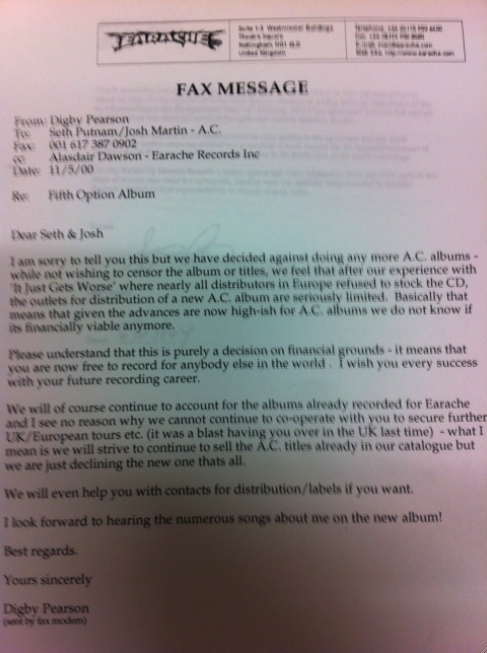
ANAL CUNT recorded 5 albums for Earache in the 90s, from their debut full-length 'Everyone Should Be Killed' in 1994 to their final album for the label, 1999's 'It Just Gets Worse'. Unlike nowadays with the internet, back in the dim dark age of the mid-90s the only way of distributing a bands music and albums in any quantities above a couple of thousand or so (which is about the limit of DIY mail-order or selling at gigs) was by a physical release distributed via the high street retail CD chains. Earache really thought AC could sell a significant amount of records, maybe tens of thousands, as we'd done exactly that with similar grindcore acts a few years beforehand.

The head buyers at the 90s era record store chains held all the power and made all the decisions regarding the type and style of music they would stock in their chain of stores, which was fair enough, since they owned their stores they could decide what to stock in them after all. Because of this- America had probably a couple of dozen, UK about 4, often anonymous "buyers"- one from each chain- who were tasked with deciding which if any new records were going to be made available in the record racks for fans to purchase each week, and if they didn't think your band would sell, you were toast.

It was far from automatic that any new metal punk or indie band would get selected to be racked in the stores, and metal labels like Earache and the like would routinely have to go the extra mile to pitch each new release to the buyers.All they cared about was filling the store with the fast selling Pop mega-sellers of the day and so bizarrely the buyer would often not even be a rock fan, sometimes it would be the classical or country buyer who was roped in for the tricky task of selecting the right metal releases for the chains group of stores in the coming weeks. It was a joke, but one we had to put up with.

If you look at the album sleeves they all refer to the band as A.C. instead of ANAL CUNT and thats an example of the label self-censoring the act in order to appease the buyers at the chains. ANAL CUNT would have been instantly rejected as an inappropriate name for racking in a family-oriented store in the mall or high street.

I'd been in contact with Seth from the very early days of the band from their late 80s inception when I helped distro their classic 88 song debut 7inch EP in the UK. Seth impressed me with his wit and creativity and single-minded pursuit of extremity probably best highlighted by their stunning and record breaking 5643 Song 7 inch EP, which remains a world-record to this day.

I was a big fan of the band and watched them develop from afar while Earache itself exploded. By the time of the early 90s the original grindcore scensters had come to regard AC as a sort of quaint joke, because they hadn't incorporated metal into the grindcore mix like the Earache bands did, and so hadn't become a huge selling band like many of their grindcore contemporaries. Earache did eventually come to its senses and sign the band in 1994 - but only after their demo for us 'Morbid Florist' was picked up and released by Relapse. I signed them mainly because they were one of the only "true grind" originators left, and Earache wanted to support that.


Back then, AC had no lyrics to speak of and no song titles- just calling them "some songs" or "hardcore song" or "more songs" and the such like.After signing with Earache we kinda persuaded them to 'play the game' a little bit by actually adopting song titles. This was so they could appear to fit in with the expectations of the record Biz at the time- we explained to the band how record retailers simply would not take an album seriously without song titles, so the band reluctantly agreed. Hence for the first time in their career actual song titles appeared on the debut album.


In the early days, AC song titles were side-splittingly funny, accurate, and clever observations of the music scene in general like, "MTV is My Source For New Music" or the grindcore scene in particular "Extreme Noise Terror are Afraid Of US" and "I Liked Earache Better When Dig Answered The Phone". Loads of fans- including me- loved the band because of theses witty and mildly confrontational song-titles.

Likewise a ton of people got into the band through their gloriously ramshackle renditions of cover songs like Bee Gees' "Stayin Alive", "Unbelievable" and " Theme From The A-team " etc.

They even took a break from their noisy output to flip the other side of the coin and release the acoustic 'Picnic of Love' 7inch, defying all conventions and taking the piss in a magnificent way.


During the course of 5 albums on Earache the band explored every taboo subject and slowly but surely upped the ante with each release, coming up with titles that were even more obnoxious and confrontational.By the final album we even had to censor titles because of concerns about being sued for libel.Eventually AC hit on the subject that I personally can not stomach and which sets off alarm bells in the record biz, namely Hitler.


The bands proposal for album 6 was all about Hitler (even though I don't believe the band are actually Nazis) which to me was simply beyond the pale so we decided not to work with them anymore.

In reality the bands charm with fans was on the wane aswell and their CD sales were down a lot and so we parted ways and dropped the band. This did not phase them in the slightest, and they promptly reverted back to being a DIY outfit.


About 6 years after parting from Earache I heard reports online that Seth had suffered a drugs overdose and subsequent coma- but luckily he survived and eventually recovered enough to take AC back on the road, still being obnoxious and causing trouble wherever they go, just like the good old days.

Theres even a new album due soon on new label PATAC of Cock Rock ballads called "Fuckin' A".